An Introduction To Muay Thai

All across the world, people have heard about it and possibly even witnessed it first hand or on television - the furious punches, bone crushing elbows, lethal and piercing kicks, and the unforgettable knees.  Although watching it on television is great, nothing begins to compare to seeing these moves executed live - with thousands of fans cheering the fighters on.

This is the wonderful world of Muay Thai kickboxing.  Muay Thai is a martial art that is unlike any other, rich in the proud heritage of an entire nation.  The style is interwoven into the well known history of the Thai people.  Even though they are gentle and fun loving people, they’ve had to defend both themselves and their land for many years against the aggressive powers and thieves.

To protect what they had, the Thai people developed a fighting system of close combat techniques that were suited to the type of rough terrain they would be fighting in.  Over the years, it eventually become a rite of passage for all Thai men to train in this amazing martial art.

In the beginning, Muay Thai proved to be a dangerous and deadly art, with the fighters having no safety gear or protection - all they had were lengths of cords in which they would wrap around their fists as gloves.  As the years progressed, rules were written into the equation to establish some protection for the fighters.

Over the years, Muay Thai has progressed as both a martial art and a style, attracting people from all over the world.  There are training facilities in Russia and the United States, with qualified instructors to help teach Muay Thai to interested students.

These days, Muay Thai is one of the most popular sports in the world.  There are a lot of television networks that broadcast Thai bouts on a weekly basis, pleasing avid fighting fans from all over the world.  International boxing is another popular sport, although most successful International boxers got their start in Muay Thai.  This goes to show why Muay Thai training is so popular - and so lethal as well.

Normally, Thai bouts are fought with 5 three minute rounds, with a two minute rest period in between the rounds.  All fights are preceded by a dance, which gives the contestants the opportunity to pay homage to their teachers.  The dance is an excellent exercise to warm up with, with plenty of symbolic meaning towards the style.

During the fights and even with training, you’ll see that each Thai boxers wears armbands and a headband.  The headband that fighters wear is believed to have been blessed by a monk or teacher, and will bestow luck upon the fighter.  Thai boxers take a lot of pride in their training and fighting, with the headband being a source of inspiration and pride for the fighter.

During training, Thai fighters will learn a lot about their spiritual well being, the history of Muay Thai, and the skills they need to survive.  Fighters that plan to compete in Thai fights will need to practice a lot, as the fights can be very demanding.  Thai training can be very brutal, all depending on where you study.  If you are studying the ancient arts of Thai boxing, you can count on the training to be very rigorous and demanding.

Although Muay Thai can be a tough art to practice, it is one of the best martial arts that you can study.  The techniques are lethal, the training is tough - yet the competitions make it all worth while!

An Introduction To Capoeira

The martial art of Capoeira was originally created over 400 years ago in Brazil by the African slaves.  This martial art is unlike any of the other martial arts there anywhere in the world, and possesses a blend of power, beauty, mental balance, physical power, music, and an overwhelming sense of art and finesse.

Upon it’s creation, Capoeira proved to the world that it can be practiced by anyone, regardless of size, weight, or age.  The style is more than a martial art, but also a social event that is rich in tradition and history.  Capoeira is a truly powerful martial art, resembling a collaboration of music, dance, and exotic movements - and even a game.

Those who witness Capoeira games will note the music.  Both the music and the lyrics play a big part in the way that the game (known as jogo) is conducted.  For the players, there are several different rhythms that call for different speeds.  When watching the game played, spectators are normally in awe from the movements.  The jogo consists of a circle, with the players in the middle and the musicians at the foot of the circle.

Players that enter the game will enter into the circle, with a spring, cartwheel, or other type of visually stunning movement.  Upon entering the circle, players will complete back and forth with various combinations of poetic movements and breathtaking aerial displays.  It takes years of practice and hard work to become great at the jogo, as it requires precision, fast movement, and flawless application of the Capoeira techniques.

From a defensive standpoint, Capoeira is flashy, very creative, and also very useful, as the techniques seem to come out of nowhere and can be very hard to defend against.  The opponent or attacker has no clue what to expect from the student.  The Capoeira student defends himself through the use of dancing movements and acrobatic techniques, executing perfect movements that up until Capoeira were only dreamt of.

Capoeira and the jogo game are really big in Brazil, with hundreds of students learning the martial art.  It isn’t one of the most popular in the United States, although it is offered.  In South America it is more of a lifestyle, with jogo games being played on a daily basis.  A lot of martial arts students don’t want to learn Capoeira for the simple fact that the movements can be a bit of a risk.  Once you see how the style is performed, it can make you cringe at any second.

Over the last couple of decades, the art has grown a lot.  In 1974, the art of Capoeira became the national sport of Brazil, proving that just about everyone in Brazil had accepted it.  As time continues to pass, you can count on more and more competitions and dojo’s to surface - introducing this truly excellent martial art to newer generations.

An Introduction To Aikido

There’s no mistaken the fact that Aikido is one of the best and most popular martial art in the United States today.  The art of Aikido is best associated with actor Steven Seagal, who made it even more popular with his movies.  Aikido is rich and history in tradition, an art that originally started in Japan back in the 1940s.

Aikido’s founder, Morihei Ueshiba, was born on December 14, 1883.  As he was growing up in modern Japan, Ueshiba witnessed the local thugs vandalize his father.  The young boy decided that he would make himself strong in order to seek revenge against the thugs.  Ueshiba was strong willed, and devoted every waking moment to physical training and martial arts.

He received a lot of certificates in jujitsu, spear fighting, and fencing.  Even though he was very impressive with his abilities, he found himself not happy with his skills.  He knew that there was more to it, and began to look into religion, hoping that he would find a greater significance with life - pursuing martial arts all the while.

Ueshiba founded the martial art of Aikido by combining both his religious beliefs and his training in martial arts.  At that time, the style was known as aikibudo, it wasn’t until 1942 that he decided to go with the name Aikido.  The style was quite different indeed, incorporating several different styles of jujitsu, aiki-jujitsu, and spear and sword fighting techniques as well.

Even though a lot of us think of Aikido as the ultimate martial art, it is an art that is based on religion and harmony.  Aikido uses joint locks, weight manipulation, and throws to achieve it’s purpose.  The martial art is very effective, which were the intentions of Ueshiba from the start.  Aikido consists of many techniques, and it is the result of Ueshiba’s creative innovation.

Aside from what many think, there really is no unified belief or philosophy in the martial art of Aikido.  While Aikido is indeed rich in heritage and religion, it believes in harmony and peace of the spirit.  By achieving a higher spiritual power, Ueshiba has always believed that the human body is capable of anything.  Even though he wanted revenge, he still stated that Aikido wasn’t about fighting, but rather a way to reconcile with the world and make every human being on giant family.

Over the years, Aikido was introduced in America with amazing results.  Steven Seagal is by far the most popular, showing the world the power and harmony of Aikido through his many movies.  There are a lot of martial arts dojo’s around North America that offer Aikido to study, possibly even some in your area.  Not only will Aikido teach you self defense, but it will also teach you harmony of the spirit and how to find inner peace as well.

An In Depth Look At Muay Thai

Also known around the world as Thai boxing, Muay Thai is an ancient art of self defense that was created and tested in battle by the fearless warriors of ancient Thailand.  Today, Muay Thai is used all around the world.  The United States Navy SEALs, Thai military, and even the CIA takes full advantage of the devastating and bone crushing techniques this martial art offers.

Unlike other martial arts, students of Thai don’t earn belts for their skills and their progression.  Instead, their skills are tested in the ring.  Since Thai fighting first began, the only things that the fighters themselves are interested in are the championship belts which showcase their dominance in Muay Thai fighting.

The skills that are taught with Muay Thai are far more dominant to other striking based martial arts.  Muay Thai uses very little grappling, but focuses more on crushing kicks, punches, and bone shattering elbows.  Students of Thai fighting can often take an opponent down with just one shot, often times breaking bones and sometimes even killing them with just one lethal kick or elbow.

The reason why Muay Thai didn’t utilize ground grappling or submission holds is because it was developed in ancient battlegrounds where there were always multiple attackers.  These attackers were knowledgeable in sword fighting skills, which made the need for a dependable martial art more or less a necessity.

Muay Thai used swords, spears, sticks, and hard strikes.  In this type of environment, you didn’t want the fight to go to the ground.  The strikes and weapon movements needed be fast, hard, and very precise.  With these types of conditions and the type of environment, Muay Thai needed be a very fast responsive martial art with an excellent weapons system.

Even though grappling and submissions were planned for Muay Thai, the martial art became more of a ring sport before grappling could be implemented.  With Thai originally being a martial art for striking purposes, a lot of martial artists have started using the techniques that have been proven time and time again with time boxing.

Although there are other martial arts that put a lot of emphasis on striking, Muay Thai is quite different.  The first area in which Muay Thai differs is the effective use of both elbows and knees.  The elbows and knees that are used with most Thai techniques are feared all around the world by boxers and other stylists.

Kicking and kneeing is the main objects in Muay Thai.  In order to become efficient with kicking, the shins need to be conditioned - which can be quite painful.  Once the Thai stylist has conditioned the nerves in his shins for impact, the shins can be used just like a club or a baseball bat.  This is something you should really see for yourself in action - as the sound of the impact alone can send chills down your back.

Through years of training and conditioning, Muay Thai fighters can become lethal and deadly weapons.  A properly trained fighter can make deadly impact, meaning that his knees, shins, and elbows are quite possibly deadlier than a gun or other type of weapon.  For this very reason - Muay Thai is one of the deadliest and most feared martial arts in the world.

All in all, Muay Thai is a great martial art for defense and competition.  Thai is one of the best martial arts in the world, proving it time and time again - in both ancient times and anytime it is used today.

A Look At Wing Chun

Up until the turn of the twentieth century, the martial art known as Wing Chun was very obscure not known much about.  Back then, Wing Chun was just getting started, not practiced by a lot of martial artists.  Over the years, it became a very dominant force in China, becoming one of the most prominent martial arts in existence.  Even today, hundreds of martial artists study Wing Chun and everything it provides them with.

The first thing that students are taught when studying Wing Chun is that they should always use force to counter force.  By using force against force, weaker and smaller fighters can easily and quickly take out bigger and stronger opponents.  Whenever they get in a confrontation, Wing Chun stylists will use their brains - and use an opponents strength and force against him.

Throughout training, a lot of emphasis is put into that very concept.  Students will learn all about force and strength, and how they can properly counter it.  What many don’t realize, is the fact that countering force requires very little strength from the stylist.  Even the weakest Wing Chun stylist can take down an opponent 3 - 4 times his size if he uses the proper technique and his opponents force against him.

Wing Chun teaches other techniques as well, such as punching, kicking, and a few grappling holds.  It doesn’t teach much grappling though, as most of the techniques use force against force through throwing and striking.  The strikes that are taught with this martial art are very fast, and aimed at vital areas on the body of the opponent.

A majority of the most vital areas on the human body are found along the center line, the very area that Wing Chun teaches stylists to protect as well as attack with their techniques.  This line is the most vital in battle, which is why martial artists should always aim their attacks for any area that exists along this line.  Most of the vital points found in the center line can be the end of the encounter if the stylist is able to land one powerful blow.

As Wing Chun emphasizes time and time again, the shortest straw between the stylist and the opponent is the center line, which is where a majority of movement takes place. Due to the linear fashion of Wing Chun, students will spend a lot of their training learning how to direct attacks as well as opposing force towards the center line.

Wing Chun is an exceptional martial art, teaching students how to use force against force in any type of encounter.  There aren’t that many grappling holds or weapons used with Wing Chun, although the techniques and moves that are taught are tried, proven, and above all - very effective for self defense.

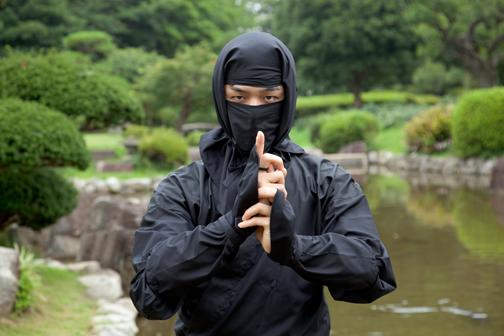
A Look At Ninjutsu

The martial art known as Ninjutsu is very secret, with a very clouded history.  The history isn’t documented all that well, as most of what is known about the martial art is that which has been passed down from generation to generation.  There are a lot of historical records that state families from the Koga region as being the creators to this very secret style.

Over 70 different Ninjutsu Ryu have been identified and discovered over the years, however most of them have died out.  A majority of them were created around a set of specific techniques and skills, although when those skills of a specific Ryu were no longer needed or wanted, the Ryu seems to die out and fade away from existence.

The art of Ninjutsu is best associated with the ninja’s from ancient Japan.  The ninja’s are well known all around the world, for their stealth and very secreted life.  The ninja is known to have went through very tough and demanding training, which hardly anyone really knows about.  Those that were actual ninja’s are either dead, or not allowed to let anyone know their true identity.

During the 1980's, when the ninja trend really hit the United States, the instructors of Ninjutsu popped out all over the place, making black a very happening color.  Years later, the trend seemed to die out, and there aren’t that many people trying to learn the art.

In regards to the art, the term of Ninjutsu doesn’t actually refer to any certain style, but rather a group of the martial arts, with each one having it’s own view that’s expressed with each of the different Ryu.  The Ryu vary, meaning that one may focus on one certain physical dynamic, while the next may be focused on redirection.

What many people aren’t aware of, is the fact that Ninjutsu involves both unarmed and armed fighting skills, along with philosophy, strategy, and history.  There are a few dojo’s that offer the art, many of them being quite comprehensive with the way they teach.

During combat, Ninjutsu focuses on distance, posture, and flow.  Stylists are taught to react to every movement, and respond in ways that will place them in the advantage position.  From being in a position of advantage, the stylist can effectively change the outcome of the encounter - quickly going from negative to positive.

Those that practice the martial art of Ninjutsu are instructed and trained to use their entire body for everything they do, which provides the most leverage and power.  Ninjutsu is well known in Japan, and for good reason.  It is a very secretive martial art, yet very powerful.  The techniques can be used or self defense, along with stealth.  It can be a great martial art to learn - if you can find a dojo that teaches it.

Secrets of the training of Bruce Lee : free ebook download

Secrets of the training of Bruce Lee : free ebook download 


Who are typical dilettantes and whom to imitate? You can find information about achievements and methods of those who are genetically gifted by nature mostly in all the books.

“Adapt what is useful, reject what is useless, and add what is specifically your own...” Bruce Lee

Let’s honestly admit, genetically gifted skills among the large army of those who want to become strong and independent are rarely met. The vast majority of people who decided to begin systematic training cannot say that they have outstanding natural skills. Therefore, the chance that you will be a rare exception from the rule is very low.

So, what training methodology should a common dilettante select, if he has skills which can’t be named as outstanding, who does not take steroids and other harmful pharmacology?

Let’s be objective. A beginner with ordinary physical capabilities will have to go through a lot of anguish and frustration to grasp one key truth: he needs a reasonable and thoughtful approach to the creation of his own (individual) program, and not to exhaust himself with “star” systems.